40 Thesis Defense Questions—and How to Answer Them
Prepare for 40 common thesis defense questions with examiner intent, answer frameworks, a practice checklist, and strategies for difficult follow-ups.
Reviewed by VivaVoce Editorial Team
The short answer
What to remember
- 01Expect questions about your problem, gap, contribution, methods, evidence, limitations, and next steps.
- 02Answer in layers: give the direct answer first, support it with one concrete piece of evidence, then state the boundary of your claim.
- 03Practice aloud. A defense evaluates spoken reasoning, not whether you can silently recognize a good answer on a page.
Read the question underneath the question
What thesis defense questions are really testing
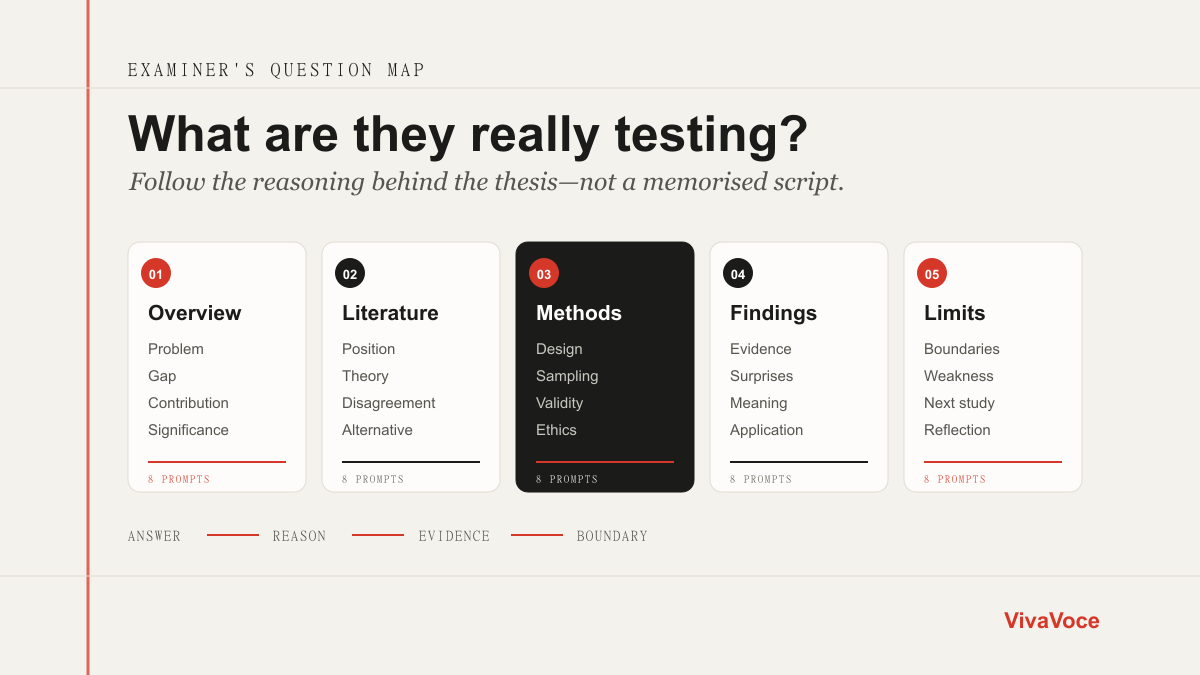
Most thesis defense questions are not trivia. Examiners are checking whether you understand the chain of decisions behind the thesis: why the problem matters, why your method fits it, what the evidence can support, and where the work stops.
That is why memorizing polished scripts can backfire. A strong answer sounds responsive because it begins with the committee’s actual concern, gives a reason, points to evidence from your thesis, and acknowledges the limit without surrendering the argument.
A four-part framework for almost any defense answer
Use the framework as a thinking sequence, not a speech you repeat word for word.
| Move | What to say | Why it works |
|---|---|---|
| 1. Answer | Give your position in one sentence. | The committee hears a clear response before the background. |
| 2. Reason | Explain the decision or logic behind it. | You demonstrate ownership rather than recall. |
| 3. Evidence | Point to a result, design choice, source, figure, or chapter. | Your answer stays anchored to the submitted work. |
| 4. Boundary | State what the evidence does not establish. | Intellectual honesty makes the main claim more credible. |
Opening and overview questions
These questions test whether you can make the whole thesis intelligible before the committee starts probing individual choices.
Can you summarize your thesis in one minute?
- What they test
- A coherent problem–method–finding–contribution arc, not a chapter list.
- Answer plan
- Name the problem, your central question, the method, the most important finding, and what that finding changes.
Why did you choose this topic?
- What they test
- An academic rationale that goes beyond personal interest.
- Answer plan
- Connect your motivation to a concrete gap, unresolved problem, or consequence in the field.
What is your central research question?
- What they test
- Precision and alignment between the question and the completed study.
- Answer plan
- State the question exactly, then explain how the design and chapters answer each part of it.
Why is this problem worth studying?
- What they test
- Significance for scholarship, practice, policy, or a clearly identified population.
- Answer plan
- Describe what remains misunderstood and the cost of leaving it unresolved.
Why did you choose this title?
- What they test
- Evidence that the title accurately represents the scope and main claim.
- Answer plan
- Explain the key terms in the title and why broader or narrower alternatives would misstate the study.
How did you define the scope of the thesis?
- What they test
- Deliberate boundaries rather than accidental omissions.
- Answer plan
- Name the included population, period, material, or variables and justify the most important exclusion.
How did the thesis change while you were researching it?
- What they test
- Reflective judgment and a willingness to follow evidence.
- Answer plan
- Describe one material change, the evidence that caused it, and how the change improved the study.
What is the strongest claim in the thesis?
- What they test
- Your ability to distinguish the main contribution from supporting findings.
- Answer plan
- State one defensible claim, identify the best evidence for it, and avoid inflating it beyond the data.
Literature, theory, and contribution questions
Here the committee is locating your work in an existing scholarly conversation. “No one has studied this” is rarely enough.
What gap in the literature does your thesis address?
- What they test
- A specific missing explanation, evidence base, population, context, or connection.
- Answer plan
- Name what the literature already establishes, what it cannot yet explain, and how your study addresses that limit.
What is your original contribution?
- What they test
- A contribution stated at the right scale.
- Answer plan
- Identify whether the contribution is empirical, theoretical, methodological, or practical, then give one concrete example.
Which authors or studies most influenced your work?
- What they test
- Command of the intellectual lineage behind your choices.
- Answer plan
- Choose two or three decisive influences and explain what you adopted, revised, or rejected from each.
Why did you choose this theoretical framework?
- What they test
- Fit between the framework, research question, and analysis.
- Answer plan
- Explain what the framework lets you see, why that matters for the question, and one thing it may obscure.
How do you define your key terms?
- What they test
- Conceptual consistency across the thesis.
- Answer plan
- Give the operational definition used in the study and distinguish it from the nearest competing definition.
Where do you disagree with the existing literature?
- What they test
- Critical engagement rather than a summary of sources.
- Answer plan
- Name the point of disagreement, show the evidence or logic behind it, and state the consequence for the field.
Why is this research timely?
- What they test
- A reason the question matters now that is more durable than a trend.
- Answer plan
- Connect a current change, new evidence, or unresolved decision to the longer-running scholarly problem.
Who should care about these findings?
- What they test
- A credible audience and pathway from result to relevance.
- Answer plan
- Name the primary scholarly or practical audience and the specific decision, model, or assumption your findings affect.
Methodology and research design questions
Method questions are usually tests of justification. “Because this is the standard method” is weaker than explaining why it answers your question under your constraints.
Why did you choose this methodology?
- What they test
- A direct link between the research question and the kind of evidence the method produces.
- Answer plan
- Start with the question, explain the evidence needed to answer it, then show why the method provides that evidence.
What alternative methods did you consider?
- What they test
- Evidence that the design was chosen comparatively, not by habit.
- Answer plan
- Name the strongest alternative, what it would have added, and the trade-off that made your method preferable.
How did you choose your sample or cases?
- What they test
- A defensible sampling logic and awareness of selection effects.
- Answer plan
- State the population, selection criteria, sample logic, and how those choices constrain generalization.
How did you establish validity, reliability, or trustworthiness?
- What they test
- Quality controls appropriate to your research tradition.
- Answer plan
- Name the relevant standard and the exact procedures you used, such as triangulation, robustness checks, calibration, or member checking.
How did you address researcher bias?
- What they test
- Recognition that the researcher and design can shape the result.
- Answer plan
- Identify the most plausible bias, the procedure used to reduce or surface it, and any residual risk.
What ethical issues did the research raise?
- What they test
- Ethics as an ongoing design responsibility, not only an approval number.
- Answer plan
- Discuss the main risk, how consent or protection worked in practice, and any tension that remained.
Why did you collect the data in this way?
- What they test
- Alignment among constructs, instruments, setting, and participants.
- Answer plan
- Explain what each instrument or source captures and why that level of resolution was necessary.
How did you analyse the data?
- What they test
- A transparent path from raw material to findings.
- Answer plan
- Walk through the analysis stages, key decisions, quality checks, and the point at which interpretations were made.
What was the hardest methodological decision?
- What they test
- Judgment under real constraints.
- Answer plan
- Describe the competing priorities, the choice you made, and what evidence or principle broke the tie.
Could another researcher replicate or transfer this study?
- What they test
- Enough procedural clarity to assess reproducibility or transferability.
- Answer plan
- Identify what is documented, what depends on context, and what another researcher would need to hold constant.
Findings and interpretation questions
These questions test whether the conclusion matches the evidence—and whether you can defend the interpretation without overstating certainty.
What is your most important finding?
- What they test
- Prioritization and significance, not a list of results.
- Answer plan
- State the finding, the evidence behind it, and why it changes the answer to your research question.
What finding surprised you most?
- What they test
- Openness to evidence that challenged your expectations.
- Answer plan
- Describe the expectation, the contradictory result, and how you tested or interpreted the difference.
How do you interpret a null or negative result?
- What they test
- Understanding that absence of evidence and evidence of absence are not identical.
- Answer plan
- State what the design could detect, offer plausible interpretations, and avoid converting uncertainty into a positive claim.
Does the evidence fully support your main claim?
- What they test
- Calibration between confidence and evidence.
- Answer plan
- Name the strongest support, the weakest link, and the exact wording that keeps the claim within the evidence.
How far can these findings be generalized?
- What they test
- A principled account of external validity or transferability.
- Answer plan
- Specify the population or contexts the evidence supports, then name where extrapolation becomes uncertain.
What competing explanation could account for the result?
- What they test
- Critical testing of your preferred interpretation.
- Answer plan
- Give the strongest rival explanation, the evidence for and against it, and why your interpretation remains more plausible or unresolved.
Why do your findings differ from previous studies?
- What they test
- A reasoned comparison across context, design, measures, or theory.
- Answer plan
- Compare the studies on the variable most likely to produce the difference and say how that comparison could be tested.
Which figure or table best represents your contribution?
- What they test
- Fluency with your own evidence and visual argument.
- Answer plan
- Choose one visual, explain what to notice first, and connect that pattern directly to the thesis claim.
Limitations, implications, and future-work questions
A limitation does not invalidate a thesis. The committee wants to know whether you understand its effect on the claim.
What is the biggest limitation of the study?
- What they test
- The limitation with the greatest consequence, not the easiest one to admit.
- Answer plan
- Name it plainly, explain which inference it affects, and state what remains defensible despite it.
What would you do differently if you started again?
- What they test
- Learning and methodological maturity, not regret.
- Answer plan
- Choose one high-impact change, explain what it would improve, and acknowledge any new trade-off it creates.
Does that limitation weaken your contribution?
- What they test
- A calibrated defense rather than denial.
- Answer plan
- Separate the claim the limitation weakens from the contribution that still stands, then justify that boundary.
What should researchers study next?
- What they test
- A next question that follows logically from your findings.
- Answer plan
- Propose one study, explain the uncertainty it resolves, and identify the design feature it needs.
What are the practical or policy implications?
- What they test
- A plausible route from evidence to action without overclaiming impact.
- Answer plan
- Name the decision-maker, the decision your evidence informs, and the condition that should limit application.
What question were you hoping we would ask?
- What they test
- Your ability to identify a strength or insight not yet visible in the discussion.
- Answer plan
- Choose a question that lets you clarify the contribution—not a rehearsed escape from the committee’s concerns.
What to do when you cannot answer a defense question
Do not bluff. First, clarify the question if its scope is unclear. Then say what you can establish from your thesis, identify the missing evidence, and explain how you would investigate the issue. “I did not test that directly” is a strong opening when it is followed by disciplined reasoning.
If the premise seems wrong, do not become combative. State the assumption you used, show where it appears in the thesis, and invite the examiner to confirm whether they are asking you to reason under a different assumption.
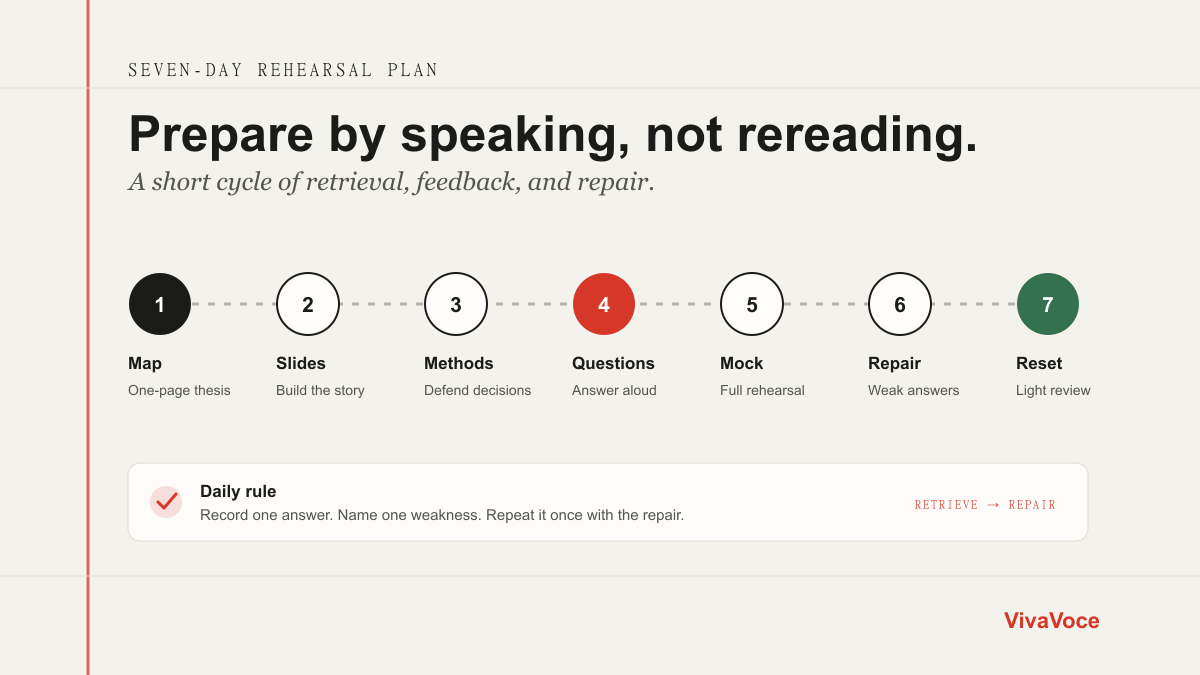
Thesis defense question practice checklist
Turn reading into rehearsal. Complete the list with your thesis open, then repeat it without notes.
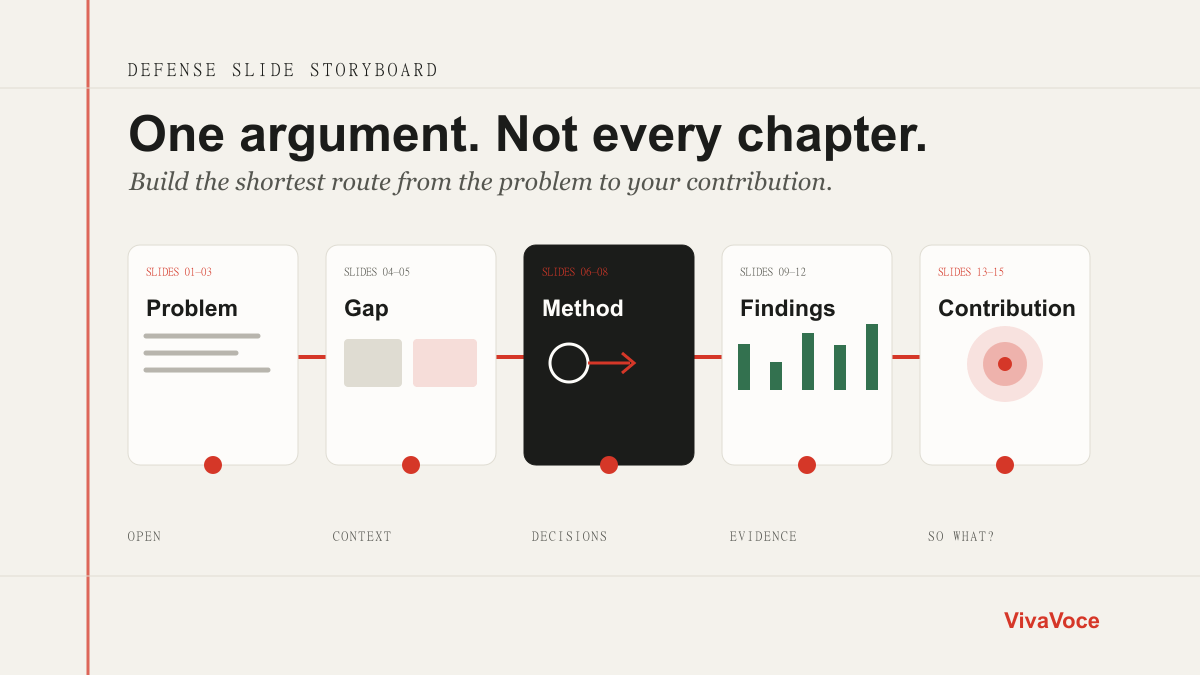
Build a one-page defense map. List the question, gap, method, three key findings, contribution, and two real limitations.
Tag your evidence. Know the page, figure, or table that supports every major claim.
Answer aloud. Practice the forty questions in random order so the wording cannot become a crutch.
Invite follow-ups. Ask a colleague to challenge the reason behind each answer instead of moving to the next prompt.
Review the recording or transcript. Cut long openings, remove hedges, and mark claims that lack a concrete example.
“The defense is a conversation: committee members may question, disagree, and build on one another’s comments.”
Frequently asked questions
What are the most common thesis defense questions?
The most common questions ask you to summarize the study, justify the topic and methods, explain the original contribution, defend the interpretation of your findings, identify limitations, and propose future research.
How long should a thesis defense answer be?
There is no universal length. Start with a direct one- or two-sentence answer, then add reasoning and evidence. Stop once you have answered the question and let the examiner choose whether to probe further.
Is it okay to say “I don’t know” in a thesis defense?
Yes, when it is honest and followed by useful reasoning. State what your study can establish, what evidence is missing, and how you would investigate the question rather than guessing.
How should I practice thesis defense questions?
Practice aloud in random order with follow-up questions. Ground every major answer in a page, figure, method choice, or result from your own thesis, then review where your spoken answers become vague or overlong.
Are viva voce questions different from thesis defense questions?
The terminology and local format vary, but both usually test your ownership of the research, methodological judgment, interpretation of evidence, contribution, and awareness of limitations. Always check your university’s specific rules.
Editorial sources
We use university and faculty guidance as a starting point. Your institution's handbook and supervisor always take precedence.
- Texas A&M University Writing Center — Dissertation DefenseUniversity guidance on preparation, presentation structure, and handling committee questions.
- University of Rochester — Preparing for a Master's DefenseGraduate-school guidance on preparing the document, talk, and question period.
- Naval Postgraduate School — Outline for Dissertation DefensesFaculty guidance on audience, timing, assumptions, limitations, applications, and rehearsal.