Thesis Defense Presentation: A Slide-by-Slide Guide
Build a clear thesis defense presentation with a slide-by-slide structure, timing table, visual examples, rehearsal plan, and Q&A preparation tips.
Reviewed by VivaVoce Editorial Team
The short answer
What to remember
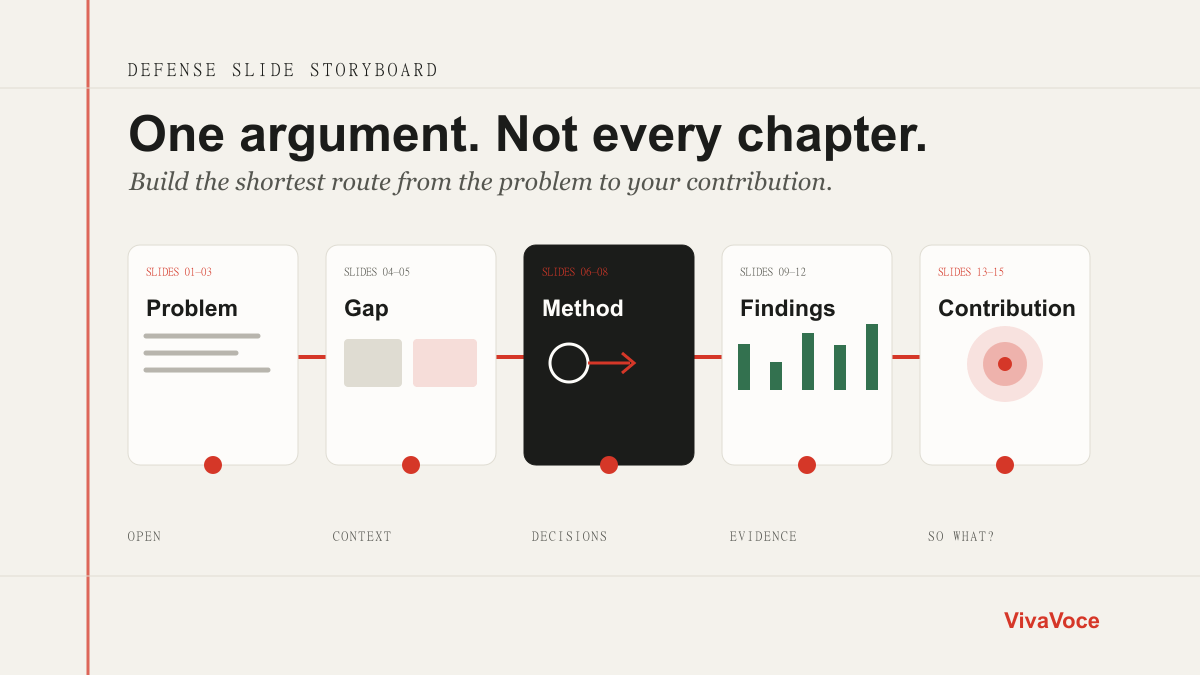
- 01Build the talk around one argument: problem → gap → method → findings → contribution.
- 02Let your university’s required duration set the slide count; a useful starting pace is roughly one substantive slide per minute, then cut.
- 03Move dense methods, secondary results, robustness checks, and extra figures into appendix slides for the question period.
The deck is an argument, not a compressed thesis
Before you build a single slide
A strong thesis defense presentation does not reproduce every chapter. It gives the committee a clean route through the decision you made, the evidence you gathered, and the contribution you can defend.
First confirm the rules with your supervisor or graduate school: total time, public or closed format, required sections, and whether questions can interrupt the talk. University guidance varies substantially, so a template should never overrule your local format.
Thesis defense presentation slide-by-slide structure
The timing below illustrates a 15-minute research talk. Scale the sections to your required duration and discipline rather than treating the numbers as rules.
| Slide or section | Job | 15-minute example |
|---|---|---|
| 1. Title + opening claim | Orient the room and state the thesis in plain language. | 0:45 |
| 2. Problem and stakes | Show what is unresolved and why the audience should care. | 1:15 |
| 3. Literature gap | Name the precise limit your study addresses. | 1:00 |
| 4. Research question | State the question or objectives exactly. | 0:45 |
| 5. Conceptual frame | Give only the concepts the audience needs to follow the analysis. | 1:00 |
| 6–7. Method and design | Explain why the design answers the question and how quality was protected. | 2:15 |
| 8–10. Key findings | Show the two or three findings that carry the argument. | 4:00 |
| 11. Interpretation | Explain what the pattern means and address the strongest rival explanation. | 1:30 |
| 12. Contribution | State what the study changes for scholarship or practice. | 1:00 |
| 13. Limitations + next step | Define the boundary of the claim and the most useful next study. | 0:45 |
| 14. Closing claim | Return to the problem and leave the room with one sentence. | 0:45 |
Make the first two minutes do real work
Open with the problem your research resolves, not a ceremonial agenda. The committee already knows the thesis title and chapter order. They need to hear the question, the stakes, and your answer.
A useful opening sequence is: the unresolved problem, one concrete consequence, the research question, and the thesis claim. If a listener can repeat those four elements after slide four, the rest of the talk has somewhere to land.
What your method slides must prove
Do not turn the methodology chapter into a diagram of every procedural step. Use the slides to defend fit and quality.
Fit. Why this method can produce the evidence needed for your research question.
Selection. How participants, cases, sources, variables, or materials were chosen.
Quality. The validity, reliability, trustworthiness, robustness, or calibration procedures that matter in your field.
Boundary. The most important inference the design cannot support.
Design results slides around claims, not chapter order
Give each results slide a declarative title that states the finding. “Result 1” makes the audience decode the visual before they know why it matters; “The effect persists across both cohorts” tells them what to inspect.
Show one visual argument at a time. Highlight the relevant series, coefficient, theme, quotation, or comparison and mute everything that does not support the spoken point. Define axes and units, label samples, and make the slide understandable without a long legend.
Choose the visual that matches the claim
| If you need to show… | Use… | Avoid… |
|---|---|---|
| Change over time | A line chart with the important interval annotated | A table of every time point |
| Difference between groups | A dot, bar, or interval plot with uncertainty where relevant | 3D effects or unlabeled axes |
| A process or model | A restrained flow diagram with one reading direction | A full methods flowchart in tiny type |
| Qualitative themes | A compact theme map plus one representative excerpt | A wall of quotations |
| A key numerical result | One large number with its unit and comparison | Copying statistical output |
| Study scope | A map, cohort diagram, or sampling frame | Decorative stock photography |
Build appendix slides for the questions you expect
Appendix slides let you keep the main talk clear without appearing unprepared when the committee asks for detail.
Full conceptual model. Include definitions and relationships omitted from the talk.
Sampling and recruitment detail. Show inclusion, exclusion, and attrition clearly.
Alternative specifications or robustness checks. Use readable summaries, not raw output.
Secondary findings. Keep useful results that do not carry the central claim.
Instrument or coding examples. Prepare one concrete example the committee can inspect.
Limitation response. Show the analysis or design feature that contains the most likely criticism.
Close on the contribution, not “Any questions?”
Your final content slide should restate the problem, the answer your evidence supports, and what the field can now see or do differently. Leave that slide visible during the transition to questions.
A separate “Questions” slide can still carry your name and thesis title, but it should not erase the intellectual ending of the talk. The contribution is the visual anchor you want behind the first question.
A rehearsal plan that improves the deck
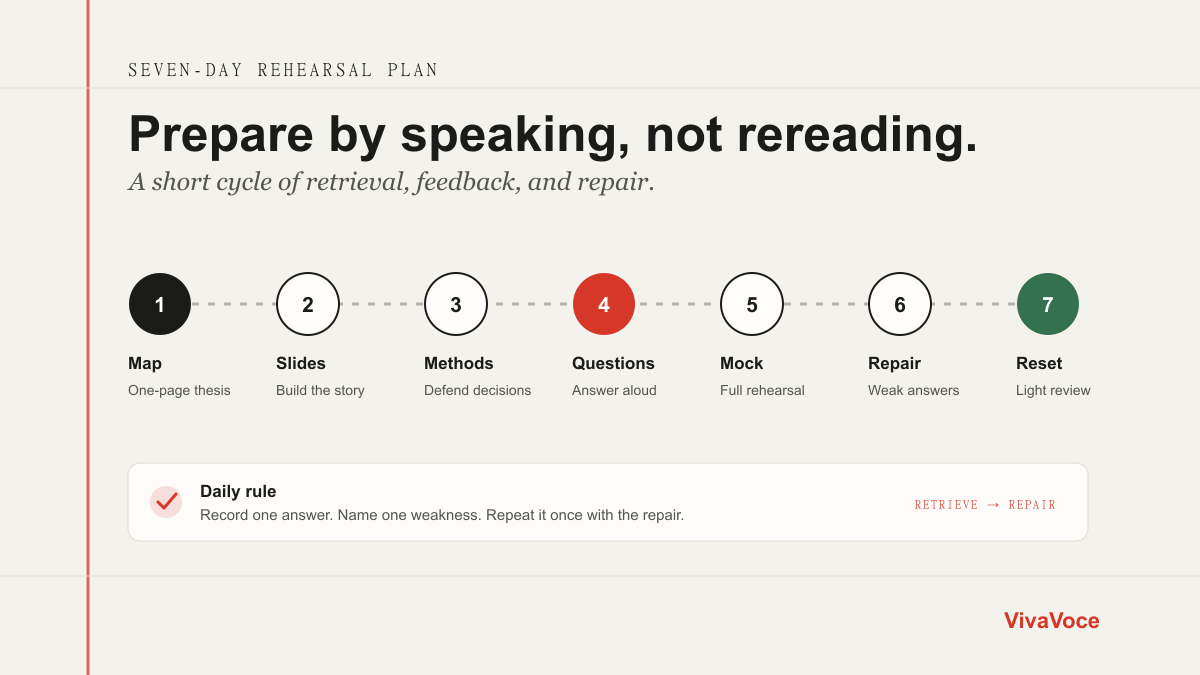
Run for structure. Speak through the whole deck without timing it. Mark every place where the story feels like a jump.
Run for time. Record a full attempt and cut repetition before increasing speaking speed.
Run for interruption. Ask a colleague to stop you on methods and findings with clarification questions.
Run without the screen. Explain the problem, method, main result, and contribution with the deck closed.
Run on the real setup. Test fonts, videos, clickers, presenter view, adapters, and a PDF backup.
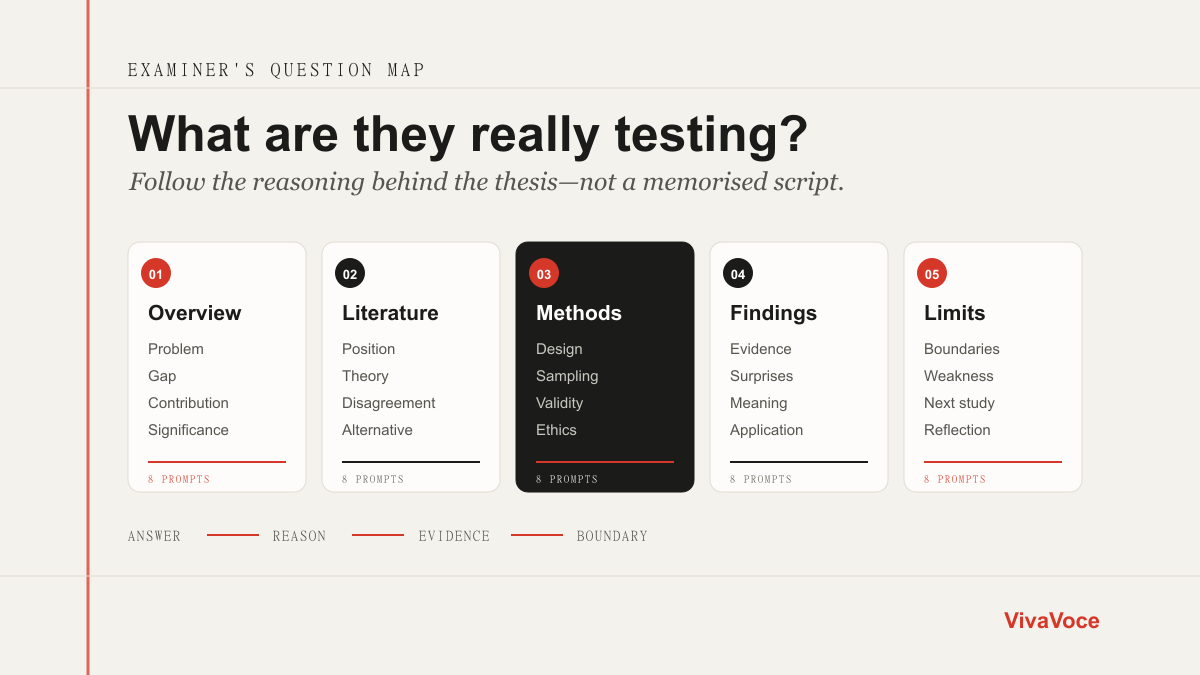
“Defense questions commonly explore the assumptions, limitations, extensions, and applications of the dissertation work.”
Frequently asked questions
How many slides should a thesis defense presentation have?
Let the required duration and complexity of the evidence determine the count. A starting pace of roughly one substantive slide per minute can help planning, but some visuals need more time and some transition slides need very little. Rehearse and cut until the talk fits comfortably.
What should be included in a thesis defense presentation?
Include the problem and stakes, literature gap, research question, essential conceptual frame, method justification, two or three key findings, interpretation, contribution, limitations, and a clear closing claim. Put supporting detail in appendix slides.
Should I include a literature review in my defense slides?
Include only the literature needed to establish the gap, frame the question, and interpret the results. A defense presentation usually benefits from a focused scholarly conversation rather than a compressed version of the full literature-review chapter.
Can I read from notes during a thesis defense?
Local rules vary, but brief prompts are usually safer than a script. Practice until you can explain the problem, method, findings, and contribution while looking at the committee rather than reading paragraphs from the slides or notes.
What backup slides should I prepare?
Prepare detailed methods, sampling, robustness checks, secondary results, definitions, instrument or coding examples, and evidence relevant to the limitation the committee is most likely to challenge.
Editorial sources
We use university and faculty guidance as a starting point. Your institution's handbook and supervisor always take precedence.
- Texas A&M University Writing Center — Dissertation DefenseUniversity guidance on preparation, presentation structure, and handling committee questions.
- Naval Postgraduate School — Outline for Dissertation DefensesFaculty guidance on audience, timing, assumptions, limitations, applications, and rehearsal.
- Carnegie Mellon University Libraries — PhD Dissertation Defense SlidesUniversity library guidance for planning and designing dissertation defense slides.