How to Prepare for a Thesis Defense: A 7-Day Plan
Prepare for your thesis defense in seven focused days with a defense map, examiner-style questions, mock practice, presentation checks, and an anxiety plan.
Reviewed by VivaVoce Editorial Team
The short answer
What to remember
- 01Reread selectively: focus on the research question, design choices, key evidence, contribution, and real limitations.
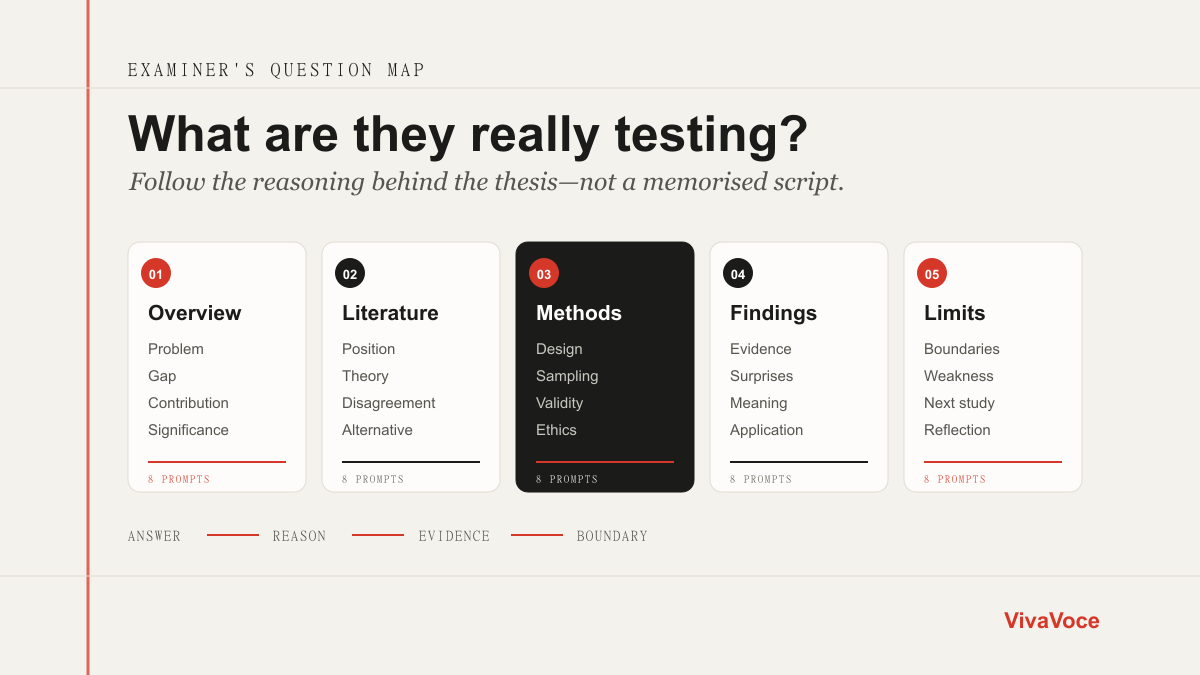
- 02Build a one-page defense map and attach a likely examiner question to every major claim.
- 03Spend more time answering aloud with follow-ups than polishing private notes you cannot use in the room.
Your thesis is the source; your judgment is the examination
Prepare to defend decisions, not recite chapters
If you are wondering how to prepare for a thesis defense, start by changing the task. You do not need to memorize the document. You need to explain why you made its most important decisions, what evidence supports its claims, and where those claims stop.
University guidance consistently emphasizes knowing the work, anticipating committee interests, rehearsing the presentation, and preparing for questions about methods, sources, interpretation, significance, and limitations. Your local handbook and supervisor should still override any generic plan.
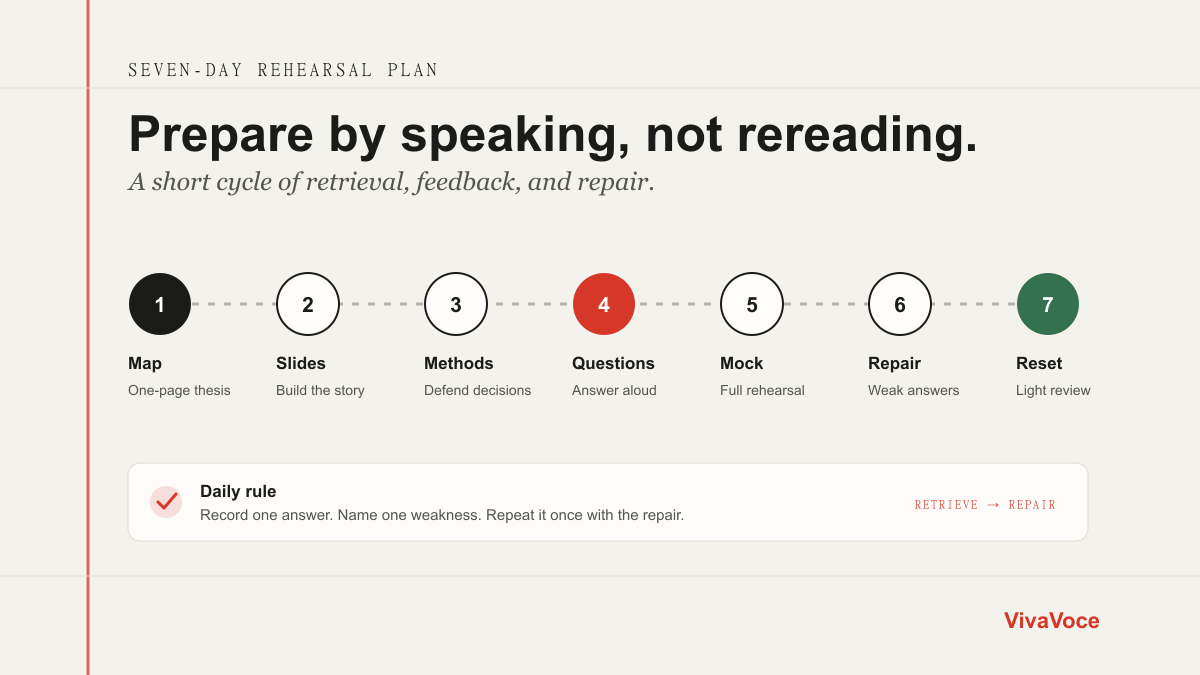
The seven-day thesis defense preparation plan
If you have more than a week, spread the same sequence out and add recovery days. If you have less, protect Days 1, 3, 5, and 7.
| Day | Focus | Concrete output | Out-loud work |
|---|---|---|---|
| 1 | Map the argument | A one-page problem → question → method → findings → contribution map | A 60-second and a 5-minute thesis summary |
| 2 | Read like an examiner | Margin notes on assumptions, surprising claims, and weak transitions | Explain why each major chapter is necessary |
| 3 | Defend the method | A method decision table with alternatives and trade-offs | Ten methodology questions with follow-ups |
| 4 | Own the findings | One evidence card for every central claim | Explain each key figure or theme without reading |
| 5 | Run a mock defense | A list of hesitations, vague answers, and missing evidence | A timed presentation plus 30–45 minutes of questions |
| 6 | Repair weak spots | Short answer plans and appendix slides for the hardest questions | A second, tougher question round |
| 7 | Stabilize | Packed materials, tested technology, and a one-page prompt sheet | One calm opening and closing—then stop |
Day 1: Build a one-page defense map
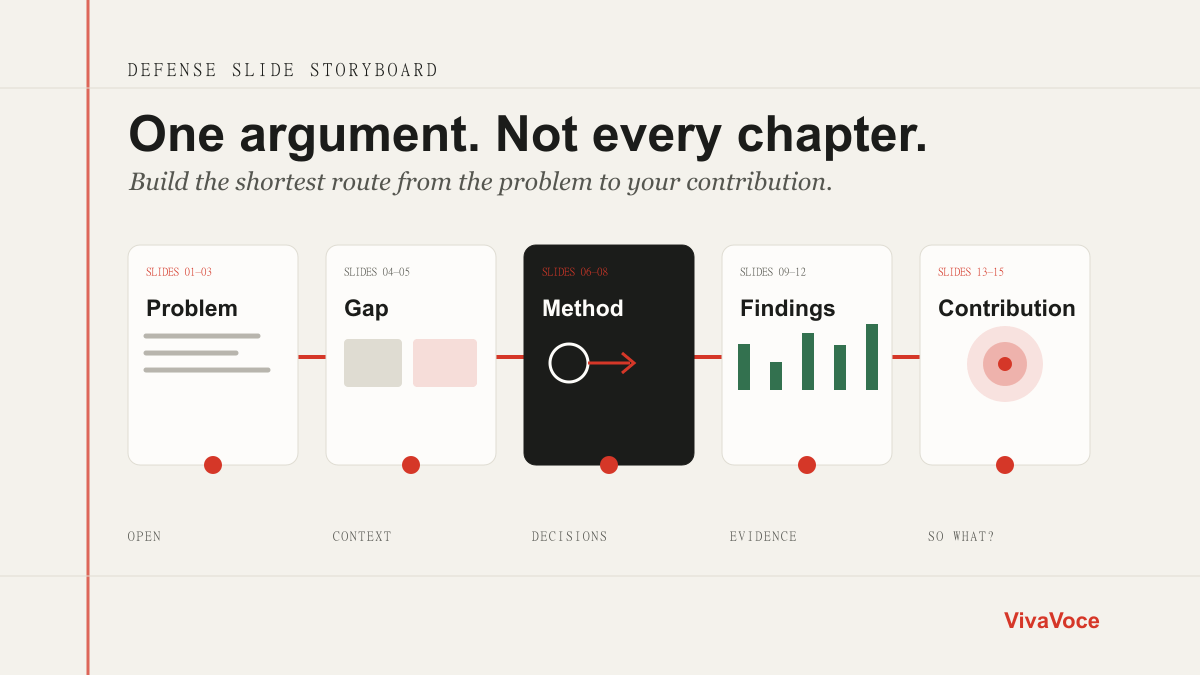
Write six headings on one page: problem, gap, research question, method, key findings, and contribution. Add two limitations at the bottom. If the page cannot hold the argument, the argument is not yet compressed enough for a spoken defense.
Now prepare two versions: a one-minute answer for the opening question and a five-minute answer for a committee member who asks you to explain the whole project. The short version reveals whether you know the hierarchy of the work; the longer version reveals whether the transitions hold.
Day 2: Reread the thesis like an examiner
Do not distribute your attention evenly. Mark the passages that create questions.
Claims without an immediate citation or result. Ask what evidence makes the sentence safe to say.
Method choices presented as obvious. List the best alternative and the trade-off you accepted.
Definitions that change across chapters. Choose the definition you can defend and explain the boundary.
Unexpected, null, or contradictory findings. Prepare more than one plausible interpretation.
Transitions from result to implication. Check whether the implication travels farther than the evidence.
Limitations buried near the end. State their actual effect on the conclusion, not only their existence.
Day 3: Make a method decision table
| Decision | Why this choice? | Best alternative | Trade-off or limit |
|---|---|---|---|
| Overall design | What evidence did the question require? | What other design could answer part of it? | What inference did you give up? |
| Sample or cases | Why are these observations informative? | Who or what is missing? | Where does generalization stop? |
| Measures or sources | How do they represent the construct? | What would measure it differently? | What error or bias remains? |
| Analysis | Why is the technique appropriate? | What other interpretation is plausible? | Which assumption matters most? |
| Quality controls | How did you test credibility? | What additional check would help? | What uncertainty cannot be removed? |
Day 4: Attach evidence to every major claim
For every central claim, make a small evidence card: the claim in one sentence, the figure/table/theme/page that supports it, the strongest competing explanation, and the boundary of the inference. These cards turn “I know it is in the thesis somewhere” into fast retrieval.
Practice describing figures and tables without reading every value. Tell the listener what to look at first, what pattern matters, and why that pattern supports the claim. For qualitative evidence, explain why the excerpt or theme is representative and how it emerged from the analysis.
Day 5: Run a real mock thesis defense
A mock defense should reproduce the cognitive work of the examination, not simply confirm that your slides advance.
Deliver the talk under the real time limit. Use the actual room or video-call setup where possible.
Move straight into questions. Do not pause to debrief the presentation first.
Ask for follow-ups. The mock examiner should challenge your reason, evidence, and boundary.
Include one hostile premise and one unclear question. Practice clarifying without becoming defensive.
Review the recording or transcript. Mark hedging, long preambles, unsupported claims, and answers that never become direct.
Day 6: Repair weak answers without scripting them
Write answer plans in bullets: direct answer, reason, evidence, boundary. Do not write paragraphs to memorize. A script makes it harder to respond when an examiner changes the wording or interrupts with a follow-up.
Add appendix slides only where a visual will genuinely answer a likely question: detailed sampling, a robustness check, a secondary result, the full conceptual model, or a close view of an important figure. Keep the main presentation focused.
Day 7: Stop adding and stabilize
Confirm the format. Time, order, room or link, public attendance, and whether interruptions are expected.
Test the technology. Slides, fonts, video, audio, clicker, adapters, presenter view, and a PDF backup.
Prepare your reference copy. Use searchable digital bookmarks or physical tabs for major chapters, figures, and methods.
Rehearse only the opening and closing. One calm run keeps the route familiar without exhausting you.
Protect sleep and food. The remaining task is retrieval and judgment, both of which need attention more than another late rewrite.
Prepare a plan for thesis defense anxiety
Anxiety often spikes when the next action is unclear. Decide in advance what you will do if your mind goes blank: put both feet on the floor, breathe out slowly, restate the question, and ask for a moment to think. Then begin with the part you can establish from the thesis.
If you do not know, say so accurately. Distinguish “I did not study that” from “the study found no effect” and from “the evidence is inconclusive.” The committee can work with intellectual honesty; it cannot work with an invented result.
“Your committee’s questions will often be specific to your work—including methodology, sources, interpretation, and how the research relates to the field.”
Frequently asked questions
How long does it take to prepare for a thesis defense?
The right lead time depends on your program, talk, and familiarity with the thesis. A focused week can organize final preparation, but earlier rehearsal gives you more time to test explanations, repair weak spots, and recover between mock sessions.
What should I study before my thesis defense?
Prioritize your research question, theoretical choices, method decisions, key evidence, contribution, limitations, and the committee’s most relevant areas of expertise. Know where major claims are supported in the thesis.
How many times should I rehearse my thesis defense?
Run at least one full timed presentation and one realistic question period. Additional practice should target specific weaknesses rather than repeating the same comfortable run. Stop before fatigue makes the final rehearsals worse.
How do I prepare for questions I cannot predict?
Practice a response process rather than every possible wording: clarify the question, answer directly, explain your reasoning, anchor it in evidence, and state the boundary. Random follow-ups in a mock defense train this flexibility.
What should I bring to a thesis defense?
Follow local rules, but common essentials include your presentation in its original format and PDF, a reference copy of the thesis with major sections bookmarked, any required forms, adapters or a clicker, water, and concise prompt notes if allowed.
Editorial sources
We use university and faculty guidance as a starting point. Your institution's handbook and supervisor always take precedence.
- Texas A&M University Writing Center — Dissertation DefenseUniversity guidance on preparation, presentation structure, and handling committee questions.
- University of Rochester — Preparing for a Master's DefenseGraduate-school guidance on preparing the document, talk, and question period.
- Naval Postgraduate School — Outline for Dissertation DefensesFaculty guidance on audience, timing, assumptions, limitations, applications, and rehearsal.