Tell Me About Yourself: Build a 60–90 Second Interview Answer
Build a clear tell me about yourself interview answer in 60–90 seconds, with a three-part framework, role-specific examples, timing, and practice tips.
Reviewed by VivaVoce Editorial Team
The short answer
What to remember
- 01Aim for 60–90 seconds: enough to establish a professional thread, not enough to retell your whole CV.
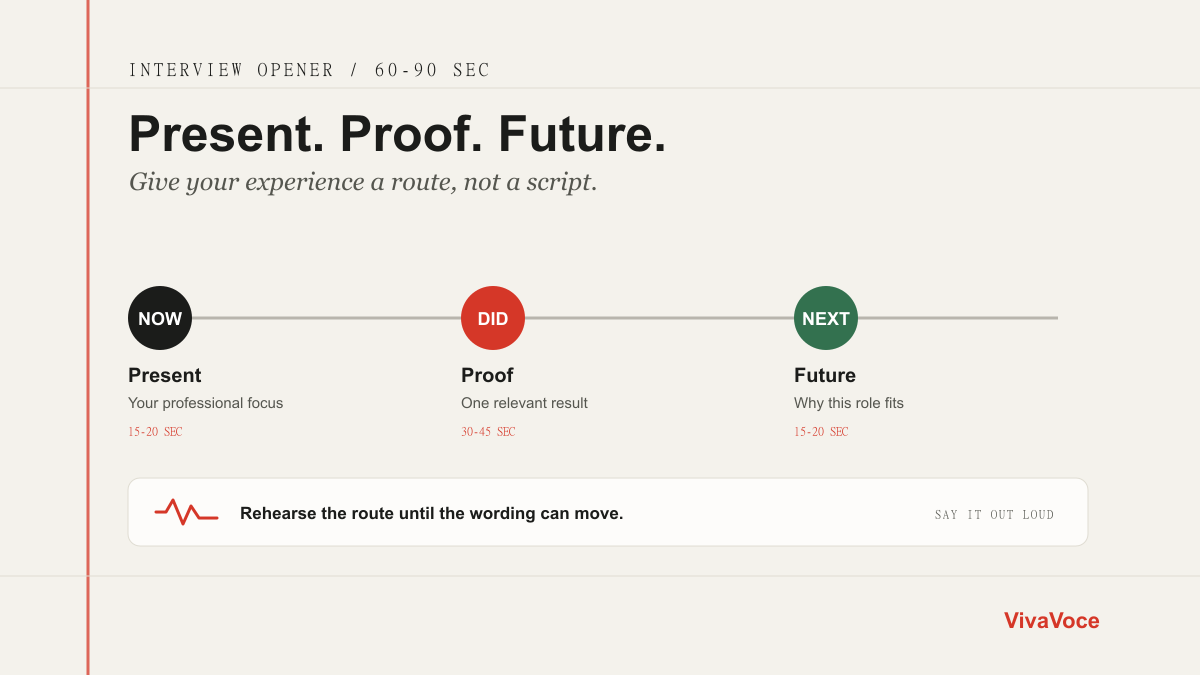
- 02Use present → proof → future: what you do now, evidence that matters for this role, and why this move makes sense.
- 03Prepare the route, not a script. Rehearse aloud until you can keep the structure while changing the wording.
An open question with a narrow job to do
What the interviewer is really asking
“Tell me about yourself” is usually an invitation to frame the interview. The interviewer already has your CV. They are listening for whether you can identify what is relevant, communicate it clearly, and connect your experience to the role in front of you.
The strongest answer is selective. It gives the listener one professional identity, one or two pieces of evidence, and a logical reason for this opportunity. Personal details belong only when they explain a relevant choice or capability.
The present–proof–future answer framework
This version keeps the useful logic of present–past–future, but forces the middle to contain evidence rather than a job-history summary.
| Part | Time | What to say | Useful prompt |
|---|---|---|---|
| Present | 15–20 sec | Your current professional focus and the kind of problem you solve | “I’m a … focused on …” |
| Proof | 30–45 sec | One or two relevant achievements, projects, or transitions | “Most recently, I … which led to …” |
| Future | 15–20 sec | Why this role is a credible next step for you and useful to them | “That is why this opportunity …” |
Build your answer in six steps
Read the job description. Circle the two capabilities the role appears to value most.
Choose your professional headline. Name your current focus in language that is both accurate and relevant.
Select one proof point. Prefer a recent example with a clear action and result over a list of responsibilities.
Add a second proof only if it adds something new. Use it to show range, progression, or a necessary career transition.
Write the bridge to this role. Connect what you have learned to the work you want to do next.
Say it without reading. Record one attempt, remove the long preamble, and repeat with the same route in fresh words.
Tell me about yourself examples by career stage
Use these as structural examples, not scripts. Replace every general claim with evidence from your own work, study, or projects.
| Situation | Lead with | Proof to include | Future bridge |
|---|---|---|---|
| Graduate | Degree focus plus the work you can now do | A project, internship, society role, or part-time result | Why this role is the right place to apply and deepen it |
| Experienced hire | Current role and strongest relevant capability | A recent, quantified achievement and your part in it | The larger problem or scope you are ready to own |
| Career changer | The common thread between old and new work | Transferable evidence plus deliberate retraining or practice | Why the change is informed, not impulsive |
| Returning to work | The professional capability you are bringing back | Earlier evidence plus current learning, freelance, or volunteer work | Why your skills and availability fit this moment |
| Manager | Team, function, or outcome you lead | How your decisions changed delivery, people, or risk | The leadership challenge that makes this move coherent |
A complete 75-second sample answer
“I’m a customer-success specialist focused on helping B2B clients adopt technical products without getting lost in the setup. In my current role I redesigned our first-30-days onboarding after noticing the same three points of confusion in support calls. I worked with product and sales to simplify the handover and add two short customer workshops; within a quarter, time to first value fell from 18 days to 11. Before that I worked in frontline support, which is where I learned to translate technical detail into the next useful action. I’m now looking for a role where I can own adoption across a more complex product, and your emphasis on customer education is what made this opportunity stand out.”
Notice what is absent: childhood, every job title, a string of adjectives, and a claim that the company is “amazing.” The answer establishes a focus, proves it, and makes the move understandable.
What to cut when the answer runs long
The autobiography opening. Start with your professional present, not where you were born or your first unrelated job.
The CV recital. Summarise the thread; let later questions open the detail.
Unproved adjectives. Replace “hard-working” and “passionate” with an action or result.
Reasons for leaving. Keep the opener forward-looking unless a transition is necessary to understand your fit.
Company flattery. Name a specific feature of the work, users, or problem that connects to your experience.
A three-round spoken rehearsal
| Round | Constraint | Listen for |
|---|---|---|
| 1 — Find the route | Speak for up to two minutes without notes | The real professional thread and your strongest evidence |
| 2 — Make it useful | Keep only details relevant to the job description | A direct opening and a specific future bridge |
| 3 — Make it natural | Deliver in 60–90 seconds with different wording | Pauses, conversational pace, and no memorised cadence |
Frequently asked questions
How long should a “tell me about yourself” answer be?
Aim for roughly 60–90 seconds. A senior or unusually complex career story may need a little longer, but the interviewer should be able to follow one clear thread and still have obvious places to ask a follow-up.
Should I mention personal information?
Keep the answer professional by default. Mention a personal detail only when it directly explains a relevant motivation, skill, move, or connection—and never share protected or private information you would rather keep out of the hiring decision.
What if I have no work experience?
Use evidence from study, projects, volunteering, societies, caregiving, or part-time work. Focus on what you did, the standard you met, and why it transfers to this role rather than apologising for a missing job title.
Should I memorise my answer?
Memorise the route and the evidence, not every sentence. Word-for-word scripts often sound brittle and can collapse when the interviewer interrupts or phrases the question differently.
How should I answer after a career break or career change?
Name the transition briefly, then spend most of the answer on the transferable thread, current evidence, and why the new direction is informed. Do not let the explanation for the change consume the proof that you can do the work.
Editorial sources
We use university career-service guidance as a starting point. Adapt every framework to your real experience, role, and local hiring context.
- Wofford College Career Center — “Tell Me About Yourself”Career-center guidance on connecting your current situation, relevant experience, values, and reason for pursuing the role.
- University of Hawaiʻi at Mānoa — “Tell Me About Yourself”University guidance for shaping a professional, role-relevant introduction rather than an autobiography.
- Swarthmore College Career Services — Interviewing GuideInterview-preparation guidance on studying the role, preparing evidence, and discussing development areas with improvement steps.