Interview Strengths and Weaknesses: Answers With Evidence
Choose interview strengths and weaknesses that fit the role, then answer with evidence, honest limits, repair plans, examples, and a rehearsal checklist.
Reviewed by VivaVoce Editorial Team
The short answer
What to remember
- 01Choose a strength the job needs and prove it with a recent action and result. The label alone is not an answer.
- 02Choose a real weakness that matters at work but is not a core requirement you cannot meet. Show its effect, repair plan, and progress.
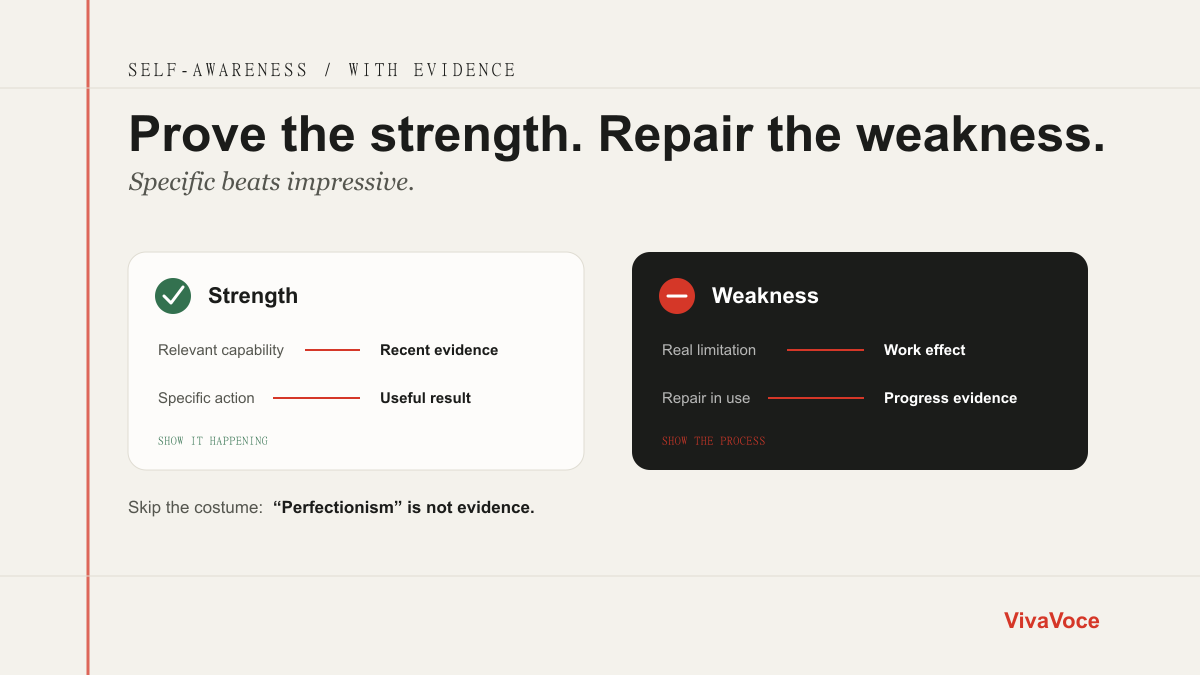
- 03Avoid disguised strengths such as perfectionism. Specific, bounded self-awareness is more credible than a flawless persona.
Self-awareness has to survive a follow-up
Strengths and weaknesses are evidence questions
When an interviewer asks about strengths, they are testing whether you understand the value you can bring to this role and whether you can prove it. When they ask about a weakness, they are testing judgment, honesty, and your ability to improve—not asking you to disqualify yourself.
Start with the job description. A good answer is true about you and useful for this position. “Communication” is too broad until you show the audience, the difficult message, what you changed, and what happened next.
Two simple answer frameworks
| Question | Framework | What makes it credible |
|---|---|---|
| Strength | Relevant strength → recent evidence → result → connection to this role | The interviewer can see you perform the strength, not merely claim it. |
| Weakness | Real limitation → effect → specific repair → evidence of progress | The improvement is active and observable, while the limitation remains honestly bounded. |
Choose a strength from the work, not a generic list
Match the job’s demands to something you have repeatedly demonstrated. These are evidence prompts, not words to copy.
Analytical judgment. A decision you improved by separating the signal from noisy data.
Clear communication. A difficult idea or decision you adapted for a particular audience.
Customer empathy. A customer behavior you noticed and converted into a useful change.
Prioritisation. A moment when you protected the right outcome under real constraints.
Collaboration. A shared result where your listening or coordination altered the route.
Learning agility. A specific capability you acquired and reliably applied under time pressure.
Attention to detail. An error, risk, or quality problem your system caught—not a claim that you “never miss anything.”
Leadership. A decision, environment, or standard you created that helped other people perform.
A strong interview answer example
“One of my strengths is making complex operational data useful to people who do not work in analytics. Last quarter our regional managers were receiving a 12-page weekly report but still asking for the same three numbers. I interviewed four managers about the decisions they made each Monday, rebuilt the report around those decisions, and added a short exception note instead of more charts. Weekly clarification requests fell by about half, and the format was adopted by the second region. That combination of analysis and practical communication is relevant here because this role works directly with non-technical teams.”
The answer names one strength, shows it under a real constraint, and closes the loop to the role. If asked for two or three strengths, give shorter evidence for each rather than one unsupported list.
How to choose a weakness without using a cliché
| Possible weakness | Honest boundary | Credible repair |
|---|---|---|
| Speaking too technically | You lose a non-specialist audience when you begin with detail. | Lead with the decision, test explanations with users, and ask someone to summarise the takeaway. |
| Delegating late | You hold work too long when the brief is still uncertain. | Define the outcome and checkpoints earlier; delegate the first testable slice rather than the finished plan. |
| Large-group speaking | You are clear in small meetings but rush in formal presentations. | Practise with recordings, mark pauses, volunteer for shorter updates, and track pace. |
| Saying yes too quickly | You accept new work before testing priority and capacity. | Use a priority check, state the trade-off, and agree what will move before committing. |
| Limited experience with one tool | You understand the work but have not used this exact platform in production. | Complete a relevant project, document what transfers, and name what you still need to learn. |
| Giving feedback too indirectly | Your wish to be considerate sometimes hides the action needed. | State the observation, effect, and request; ask the listener to reflect it back. |
A credible biggest-weakness answer
“I used to wait too long to share an early draft because I wanted the analysis to feel resolved first. On a recent pricing project that meant the sales lead saw my assumptions later than she should have, and we had to redo part of the segmentation. I now schedule a 20-minute assumptions review before I build the full model and label unresolved decisions explicitly. On the next two projects that surfaced missing field knowledge in the first week instead of at final review. I still have to resist polishing before alignment, but the checkpoint has made the risk visible.”
This answer does not pretend the weakness has vanished. It shows a real work effect, accepts responsibility, and gives evidence that the repair changes the process.
Rehearsal checklist for both answers
It is specific. A listener could ask about the event, action, measure, or improvement system.
It is relevant. The strength supports the role; the weakness does not contradict a non-negotiable requirement.
It is proportionate. You neither minimise the weakness nor turn a small development area into a confession.
It sounds like you. Your wording is conversational and your evidence comes from work you actually did.
It survives “Tell me more.” You can explain the reason, your part, the result, and what still needs work without changing the story.
Frequently asked questions
What are good strengths to say in an interview?
A good strength is both true and important to the role—for example analytical judgment, customer empathy, prioritisation, clear communication, or learning agility. Its quality depends on the recent evidence you use to prove it.
What are good weaknesses for a job interview?
Choose a genuine, work-relevant limitation you understand and are actively improving, such as delegating late, speaking too technically, or limited exposure to a tool. Avoid selecting a core requirement you currently cannot meet.
Can I say perfectionism is my weakness?
Only if you can name its real negative effect and a credible repair. The word is so often used as a disguised strength that a more concrete description—such as delaying feedback by over-polishing—will usually be more believable.
How many strengths and weaknesses should I give?
Answer the number requested. If the question is singular, one well-supported answer is usually stronger than a list. If asked for several, give concise evidence for each and avoid repeating the same capability under different names.
Should my weakness be completely fixed?
No. Show real progress and a working improvement process without pretending the limitation has disappeared. Interviewers are testing self-awareness and response to development, not perfection.
Editorial sources
We use university career-service guidance as a starting point. Adapt every framework to your real experience, role, and local hiring context.
- University of Houston Career Center — Strengths and WeaknessesCareer-center guidance on selecting relevant strengths, avoiding clichés, and pairing a weakness with an action plan.
- University of Hawaiʻi at Mānoa — Strengths and WeaknessesUniversity guidance on supporting strengths with examples and discussing weaknesses honestly and constructively.
- Swarthmore College Career Services — Interviewing GuideInterview-preparation guidance on studying the role, preparing evidence, and discussing development areas with improvement steps.