The STAR Interview Method: Build Answers That Do Not Ramble
Use the STAR interview method to answer behavioral questions clearly, with a story-bank template, sample answers, timing guide, and spoken practice drills.
Reviewed by VivaVoce Editorial Team
The short answer
What to remember
- 01STAR means situation, task, action, result. Use it for questions that ask for a real example from your past.
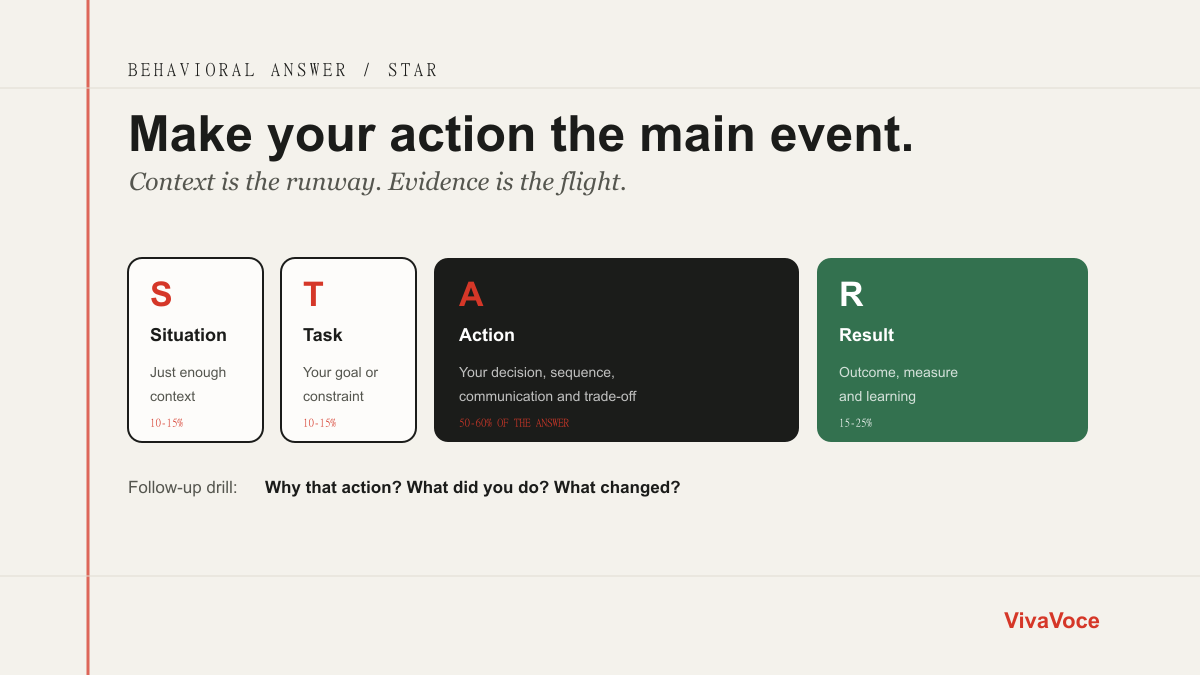
- 02Keep situation and task short. The action—what you specifically decided, said, built, or changed—should take most of the answer.
- 03Prepare a flexible story bank, not one story per possible question. Rehearse follow-ups about your reason, trade-off, and result.
A story structure, not a script template
Use STAR when the interviewer asks for evidence
Behavioral questions often begin with “Tell me about a time,” “Give me an example,” or “Describe a situation.” They are asking for evidence of how you behaved, not a theory of what a good employee should do. The STAR interview method keeps that evidence understandable.
STAR is less useful for factual questions, motivation questions, and broad introductions. If the interviewer asks why you want the role, answer that directly. Do not force every response through four labels.
The STAR interview method, part by part
| Part | Share of answer | Include | Avoid |
|---|---|---|---|
| Situation | 10–15% | The setting and one piece of context needed to understand the stakes | A history of the company, team, or project |
| Task | 10–15% | Your responsibility, goal, constraint, or problem | Blurring the team’s goal with what you owned |
| Action | 50–60% | Your decisions, sequence, communication, tools, and trade-offs | Hiding inside “we” or listing routine duties |
| Result | 15–25% | A measured outcome, learning, feedback, or change that followed | Claiming a team result without explaining your contribution |
Build a six-story interview bank
Choose stories with different evidence. A strong story can answer several questions when you shift the emphasis honestly.
A difficult problem. Show analysis, judgment, and how you worked when the answer was not obvious.
A conflict or disagreement. Show listening, a professional challenge, and movement toward a useful outcome.
A mistake or setback. Show ownership, repair, and a concrete change to your process.
A result you improved. Show the starting point, your intervention, and a credible measure of change.
Influence without authority. Show how you earned agreement rather than relying on title or escalation.
A fast learning curve. Show how you identified what mattered, found help, and applied the learning.
Eight STAR interview questions to practise
Answer each with a real event. After the first answer, ask yourself the follow-up in the answer plan.
Tell me about a time you solved a difficult problem.
- What they test
- Structured thinking, resourcefulness, and ownership.
- Answer plan
- Establish the constraint, explain the options you considered, then defend why you chose your action.
Describe a disagreement with a colleague.
- What they test
- Emotional control, listening, and productive challenge.
- Answer plan
- State the genuine disagreement without making the other person a villain; show what you changed after listening.
Tell me about a mistake you made.
- What they test
- Accountability, self-awareness, and prevention.
- Answer plan
- Name the mistake directly, repair the effect, and explain the process change that outlasted the apology.
Give an example of working under a tight deadline.
- What they test
- Prioritisation and communication under pressure.
- Answer plan
- Explain what you cut, protected, delegated, and communicated—not only that you worked late.
Tell me about a time you influenced someone.
- What they test
- Stakeholder judgment and evidence-based persuasion.
- Answer plan
- Show what mattered to them, how you adapted the case, and what they decided.
Describe a time you improved a process.
- What they test
- Initiative and measurable improvement.
- Answer plan
- Give the baseline, the change you owned, and the result after implementation.
Tell me about a time you received difficult feedback.
- What they test
- Coachability without passive agreement.
- Answer plan
- Explain how you tested the feedback, what you changed, and what improved.
Give an example of learning something quickly.
- What they test
- Learning strategy and reliable application.
- Answer plan
- Name the gap, your learning route, the moment you applied it, and how you checked your work.
Weak versus strong STAR evidence
| Weak version | Why it fails | Stronger move |
|---|---|---|
| “We delivered the project successfully.” | The listener cannot see your contribution or the standard of success. | Name your decision and give the relevant delivery, quality, cost, or customer outcome. |
| “There was a lot going on.” | The situation is vague rather than concise. | Name the one constraint that made your action difficult or important. |
| “I communicated with stakeholders.” | It names a category of work, not what you did. | Explain whom you spoke to, what changed in your message, and the decision it enabled. |
| “I learned to manage my time.” | The learning has no evidence. | Name the planning change and show what happened the next time. |
A STAR method answer example
Question: “Tell me about a time you improved a process.” Situation and task: “Our support team was missing the same product issue across separate tickets, and I was asked to reduce repeat escalations before the next release.” Action: “I reviewed six weeks of tags, found that agents described the issue in five different ways, and created one diagnostic flow with the product specialist. I tested it with two agents, rewrote the unclear step, and ran a 20-minute team walkthrough. I also added a weekly check so the flow would not go stale.” Result: “Repeat escalations fell from 31 to 18 in the following month, and the product team received cleaner examples for the permanent fix.”
The answer is credible because the action can be inspected. A follow-up can explore the tag analysis, why the first draft failed, how the product specialist contributed, or whether the result lasted.
Rehearse STAR answers without sounding scripted
Write four bullets, not four paragraphs. Each bullet should hold facts and decisions, not polished sentences.
Give the answer in 90 seconds. If it runs long, cut context before cutting your action.
Retell it in 45 seconds. This reveals the essential causal line and prepares you for an interrupting interviewer.
Take three follow-ups. Practise “Why?”, “What did you personally do?”, and “What would you change?”
Check the job signal. Finish by asking which requirement this story actually proves.
Frequently asked questions
What does STAR stand for in an interview?
STAR stands for situation, task, action, and result. It is a structure for giving a specific past example when an interviewer asks a behavioral question.
How long should a STAR interview answer be?
Many answers work well in roughly 60–120 seconds. Complexity varies, but keep the context brief enough that the interviewer hears your specific action and result while the question is still clear.
Can I use the same STAR story for different questions?
Yes, if the story genuinely contains evidence for both questions. Change the emphasis, not the facts. A process-improvement story might show analysis in one answer and influence in another.
What if the result was not successful?
A mixed or unsuccessful result can still be strong evidence if you own your decisions, explain what you learned, and show the change you made afterward. Do not retrofit a happy ending the event did not have.
Should I use STAR for every interview question?
No. Use it when a question asks for a past example. Answer factual, technical, motivational, hypothetical, and introductory questions in the structure that fits them.
Editorial sources
We use university career-service guidance as a starting point. Adapt every framework to your real experience, role, and local hiring context.
- University of Virginia Career Center — STAR InterviewsCareer-center guidance on using a specific situation, your own actions, and job-relevant skills in concise behavioral stories.
- UMBC Career Center — STAR MethodUniversity guidance for structuring behavioral interview answers around situation, task, action, and result.
- Michigan Tech Career Services — Behavioral InterviewsCareer-services guidance on preparing concrete examples for behavioral questions and explaining individual contributions.